Implementing Retrieval-Augmented Generation (RAG) in Your Enterprise: Use Cases, Architecture & Best Practices
The rise of AI chatbots marks a defining moment in digital transformation. These systems showcase impressive fluency, contextual understanding, and responsiveness yet often fail when asked organization-specific or time-sensitive questions. Retrieval-Augmented Generation (RAG) bridges that gap. By combining the reasoning power of Large Language Models (LLMs) with real, enterprise data, RAG ensures every AI answer is accurate, context-aware, and trustworthy.
This article explores RAG’s importance, working architecture, use cases, and best practices for implementation — helping enterprises build grounded, reliable AI systems.
The Limitation of Traditional AI Chatbots
LLMs are great generalists but poor specialists.
Ask a chatbot, “What’s the refund policy for pre-orders before July?” — it might answer confidently but incorrectly. That’s because it only knows the open internet, not your internal policies or databases.
Fine-tuning or retraining helps, but it’s costly, time-consuming, and quickly outdated. The real problem isn’t intelligence — it’s information. Even the smartest model can’t be useful if it doesn’t know your company’s data.
Enter RAG, which ensures AI systems learn from your verified, private knowledge base, not just public data.
What is Retrieval-Augmented Generation (RAG)?
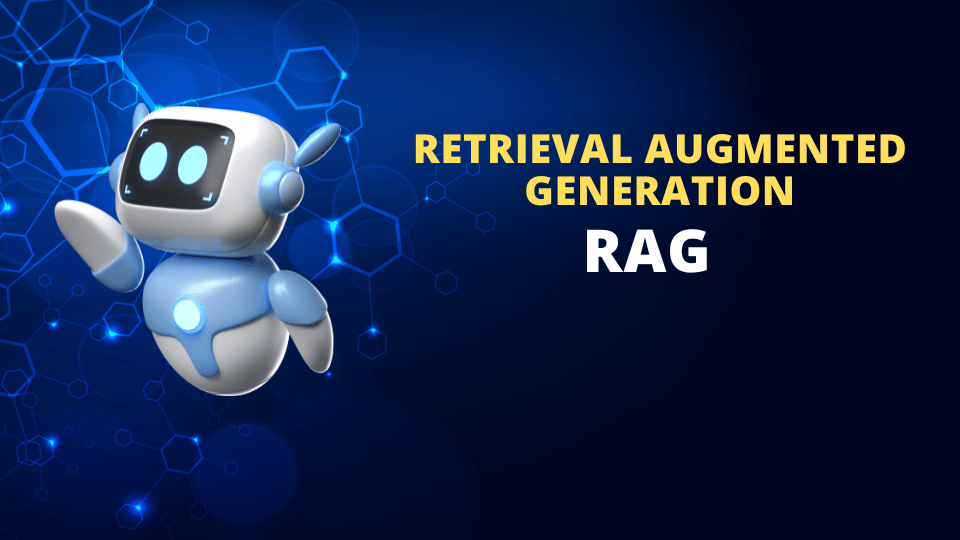
RAG is a method that enhances large language models by connecting them to an external knowledge source — such as your internal databases, documentation, or wikis — before they generate a response.
Traditional LLMs rely only on static, pre-trained data. RAG introduces a retrieval step, allowing the AI to pull up-to-date, domain-specific information and use it as context when forming an answer.
In simple terms, RAG makes generative AI dynamic, accurate, and context-sensitive letting businesses extend existing models without retraining from scratch.
Why Retrieval-Augmented Generation Matters
Modern enterprises rely heavily on AI assistants for customer service, analytics, and internal knowledge access. But traditional LLMs face four major issues:
-
Incorrect or fabricated answers due to lack of real data.
-
Outdated responses that don’t reflect new policies or updates.
-
Generic or vague results that don’t align with your brand voice.
-
Confusion over internal terminology across departments.
An LLM can be thought of as an overconfident intern — smart but unaware of internal workings. RAG fixes this by grounding every answer in verified company knowledge, ensuring your AI systems speak with authority and accuracy.
Advantages of RAG
-
Improved Factual Accuracy
Retrieves verified, up-to-date information before generating a response — minimizing hallucinations and misinformation. -
Enhanced Context Relevance
Provides answers tailored to your organization’s specific language, policies, and data. -
No Continuous Retraining Needed
Update the knowledge base instead of fine-tuning the model repeatedly. -
Transparency and Trust
Offers citations and references for every answer — ideal for compliance and audit trails. -
Cost Efficiency
Reduces infrastructure and compute costs by separating retrieval from generation.
Disadvantages of RAG
-
Dependence on Data Quality — Poorly maintained or unstructured knowledge bases reduce accuracy.
-
Increased System Complexity — Requires retrieval infrastructure (vector DBs, chunking logic).
-
Higher Latency — Retrieval + generation takes longer than direct LLM calls.
-
Context Window Limits — Models can only process a limited amount of text per query.
-
Risk of Bias or Misinterpretation — If the data is biased or inconsistent, the system can echo that bias.
RAG Architecture
Before generating any answer, RAG follows a carefully structured pipeline that ensures accuracy and contextual grounding.
Each stage — from understanding the query to retrieving relevant data — plays a crucial role in transforming a generic model into a domain-aware system.
Here’s how the process works step-by-step:
-
Query Processing: The user’s question is cleaned, normalized, and converted into a semantic vector that captures its intent and meaning.
-
Embedding Model: The system uses models like OpenAI or Sentence-BERT to convert text into embeddings — numerical representations that encode meaning beyond keywords.
-
Vector Database Retrieval: The query vector is compared against stored document embeddings in a vector database (e.g., Pinecone, FAISS, or Weaviate) to find the most relevant results.
-
Context Injection: The top retrieved passages are passed to the LLM, acting as factual context or “memory” for the model.
-
Response Generation: The LLM processes both the query and retrieved information to generate a coherent, grounded, and accurate answer.
-
Final Output: The result is a context-rich, domain-specific response — blending the general intelligence of the model with your enterprise’s private knowledge.

Best Practices for Implementation
Building a robust RAG system requires both technical precision and data discipline.
These best practices help ensure your system is reliable, efficient, and scalable — while maintaining security and factual accuracy.
-
Optimize Chunk Size (200–500 Tokens): Keep chunks large enough to retain context but small enough for fast, accurate retrieval.
-
Maintain Rich Metadata: Tag chunks with fields like author, date, and document type to improve filtering and traceability.
-
Use Hybrid Search: Combine semantic (dense) and keyword (sparse) search to balance accuracy and recall.
-
Regularly Refresh Embeddings and Index: Update embeddings whenever content changes to reflect the latest information.
-
Implement Re-Ranking Before Generation: Use models like BM25 or cross-encoders to reorder retrieved chunks for better precision.
-
Introduce Feedback Loops: Collect user ratings and performance metrics (Recall@K, nDCG) to continuously optimize the pipeline.
-
Use Summarization or Compression: When multiple chunks are retrieved, summarize them to fit within the model’s context window without losing essential meaning.
-
Apply Governance and Access Control: Restrict retrieval access based on user roles and ensure compliance with data privacy regulations like GDPR.
Enterprise Use Cases
RAG can revolutionize how enterprises handle knowledge, support, and decision-making.
By grounding AI systems in proprietary data, it transforms generic chatbots into domain specialists that deliver precise, explainable answers.
-
Customer Support
Empower virtual agents to fetch accurate answers from internal FAQs, manuals, or policies — ensuring consistent and up-to-date responses for users. -
Legal & Compliance
Retrieve relevant contract clauses, legal references, and compliance policies to generate fact-checked responses for internal teams and clients. -
Healthcare & Clinical Decision Support
Support medical staff by retrieving patient data, clinical guidelines, and research insights to assist in evidence-based decision-making. -
Finance & Risk Management
Extract contextual data from reports, policies, and financial records to create detailed, data-backed summaries or compliance insights. -
Software & Developer Support
Help developers quickly access internal documentation, API references, and system diagrams — reducing manual searching and onboarding time. -
Enterprise Knowledge Management
Enable employees to query vast document repositories conversationally, turning static files into dynamic, searchable knowledge assets.
The Future of RAG
RAG is evolving from static pipelines into adaptive, memory-driven ecosystems.
-
Memory-Augmented RAG: Enables AI to retain context across sessions.
-
Multi-Modal Retrieval: Integrates text, PDFs, images, and videos.
-
Adaptive Pipelines: Automatically choose retrieval strategy per query.
-
Agentic RAG: AI agents that autonomously refine retrieval and synthesis.
Key Takeaways
-
RAG bridges the gap between intelligence and information, empowering enterprise-grade AI.
-
It turns generic LLMs into domain-aware experts capable of real-world accuracy.
-
Success depends on data quality, metadata management, and feedback loops.
-
With proper governance and retrieval precision, RAG becomes the foundation of reliable AI adoption across industries.